
Relational foundations
Primary keys and relationships
Distinguish primary and foreign keys using the shared Customers and Orders data.
Lesson 3 of 84
Reading: about 3 min
Lesson + practice: about 12 min
Difficulty: Beginner
On this page3 sections
A primary key consists of one or more columns that uniquely identify each row. Primary-key values cannot be NULL. A foreign key consists of one or more columns whose non-NULL values reference a primary key or UNIQUE key, usually in another table. In a one-to-many relationship, multiple rows can reference the same parent key.
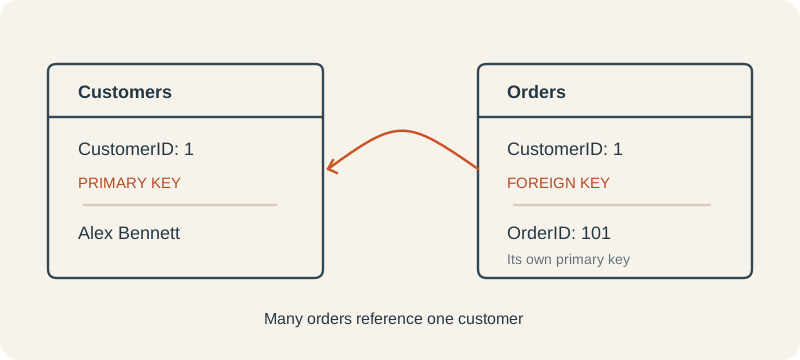
Customers and Orders
Customers.CustomerID is the primary key of Customers. Orders.OrderID is the primary key of Orders. Orders.CustomerID is the foreign-key column that references Customers.CustomerID. Each order in this dataset has one valid customer; a customer can have multiple orders.
This read-only query shows three order keys and their customer references on DDI_SQL_Training dataset version 1.0.0 using SQL Server 2019 or later. You can run it after setting up the practice database in lesson 5; Chapters 2 and 3 explain its query clauses.
SELECT TOP (3) OrderID, CustomerID, OrderStatus
FROM dbo.Orders
ORDER BY OrderID;| OrderID | CustomerID | OrderStatus |
|---|---|---|
| 1 | 1 | Cancelled |
| 2 | 2 | Pending |
| 3 | 3 | Shipped |
Order 1 refers to customer 1, Alex Bennett. The Orders table stores the customer ID, not a second copy of Alex’s name. SQL Server checks the foreign-key rule when data is inserted or changed.
Optional relationships
Orders.SalesEmployeeID is a nullable foreign key to Employees.EmployeeID. In this design, NULL means no employee is assigned to that order. By contrast, Orders.CustomerID is required and cannot be NULL.
Check your understanding
Can two orders have CustomerID 1? Can two orders have OrderID 1?
Reveal answer
Yes, multiple orders can reference the same customer. No, each OrderID must be unique because it is the Orders primary key.
Your progress
Reveal the check answer or reach the end to complete this lesson.